


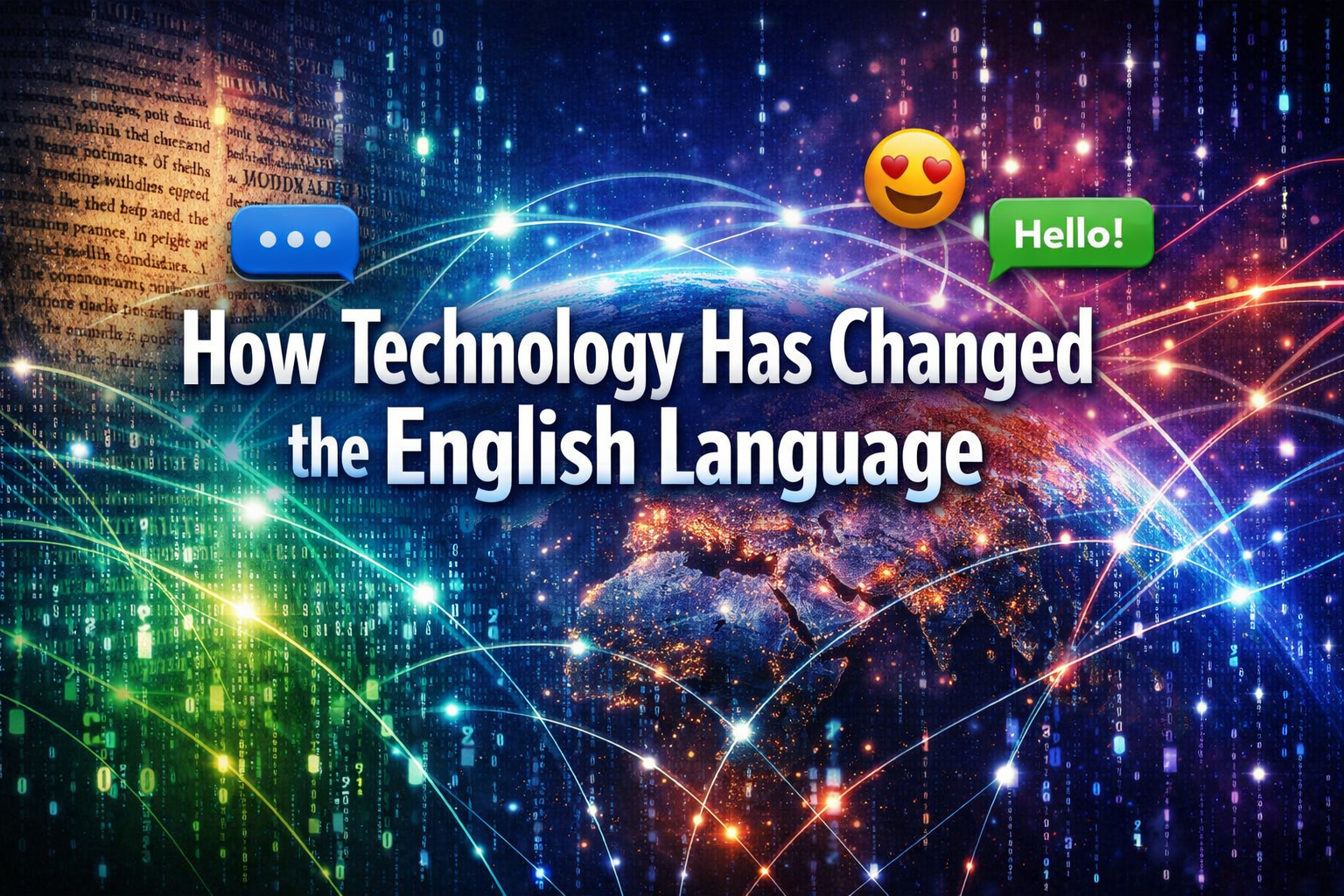
The English language, a dynamic and ever-evolving entity, stands at a pivotal juncture in 2026, profoundly reshaped by the relentless march of technological innovation. From the very first telegraph to the latest advancements in artificial intelligence, technology has not merely influenced but fundamentally transformed how we speak, write, and understand English. This article explores in depth how technology has changed the English language, examining everything from vocabulary expansion and grammatical shifts to the rise of new communication styles and the global spread of English as a digital lingua franca. Join us as we uncover the fascinating linguistic revolution unfolding before our eyes.
Key Takeaways
- Vocabulary Expansion: Technology has introduced a vast array of new words, acronyms, and specialized jargon into the English lexicon, covering everything from computing terms to internet slang.
- Grammatical and Stylistic Shifts: Digital communication fosters more informal, concise, and often less grammatically strict forms of English, challenging traditional norms.
- New Communication Modalities: The rise of texting, social media, and instant messaging has created entirely new ways of interacting, complete with unique linguistic conventions like emojis and abbreviations.
- Globalization of English: Technology has accelerated English’s role as a global language, but also led to the emergence of diverse Englishes influenced by regional digital communities.
- Accessibility and AI Impact: Tools like speech-to-text, translation software, and AI language models are changing how we interact with and learn English, making it more accessible while also raising questions about linguistic authenticity.
The Digital Dictionary: How Technology Has Changed the English Language’s Vocabulary
The most immediate and perhaps most obvious way technology has changed the English language is through the explosion of new vocabulary. Every new invention, every software update, and every online trend seems to bring with it a fresh set of words and phrases that quickly embed themselves into our daily conversations. This lexical expansion is not merely additive; it often redefines existing words or creates entirely new categories of expression.
Consider the dawn of computing. Words like “software,” “hardware,” “bug,” “debug,” and “interface” were once highly specialized jargon, if they existed at all in their current context. Today, they are commonplace. As the internet gained prominence, terms such as “website,” “email,” “download,” “upload,” “browser,” and “hyperlink” became essential components of our vocabulary. The late 1990s and early 2000s ushered in the era of social media, giving us “blog,” “tweet,” “friend” (as a verb), “unfriend,” “hashtag,” and “selfie.” Each of these words reflects a new concept or action made possible by technology [1].
Beyond completely new words, technology also recontextualizes existing ones. Take “mouse.” Once exclusively a small rodent, it now primarily refers to a computer input device for many. “Cloud,” traditionally a weather phenomenon, now frequently denotes an online storage and computing infrastructure. “Stream” moved from flowing water to continuous digital media. This semantic shift highlights how technology can borrow and repurpose words, giving them new, often more prevalent, meanings.
The rapid pace of technological development means this vocabulary evolution is ongoing. In 2026, we regularly encounter terms like “AI,” “machine learning,” “blockchain,” “cryptocurrency,” “NFT,” “metaverse,” and “smart contract” – words that were largely unknown to the general public just a decade or two ago. This constant influx enriches the English language but also demands a continuous adaptation from its speakers.
Table 1: Examples of Tech-Induced Vocabulary Shifts
| Original Meaning (Pre-Tech) | Tech Meaning (2026) | Example Usage |
|---|---|---|
| Mouse (Rodent) | Computer input device | “My wireless mouse needs new batteries.” |
| Cloud (Weather) | Online data storage | “I store all my photos in the cloud.” |
| Stream (Flowing water) | Continuous media playback | “Let’s stream the new movie tonight.” |
| Cookie (Baked good) | Web data tracker | “This website uses cookies to personalize your experience.” |
| Hack (Chop with an axe) | Unauthorized system access | “The company’s server was hacked last night.” |
| Firewall (Wall to stop fire) | Network security system | “Our firewall blocks malicious attacks.” |
Acronyms and initialisms also flourish in the tech world. “URL,” “FAQ,” “PDF,” “USB,” “Wi-Fi,” “GPS,” and “CAPTCHA” are now universally recognized. While acronyms existed before technology, their prevalence and rapid adoption have certainly been amplified by the need for concise communication in digital spaces.
The phenomenon of “verbification” is another notable trend. Nouns and adjectives readily become verbs in the tech sphere. We “google” information, “text” messages, “friend” someone on social media, “ping” a colleague, and “zoom” into meetings. This linguistic agility allows English to adapt swiftly to new actions and interactions facilitated by technology, showcasing the language’s inherent flexibility [2].
Shifting Sands of Grammar and Style: How Technology Has Changed the English Language’s Structure
Beyond individual words, technology has profoundly influenced the grammatical and stylistic norms of the English language. Digital communication platforms, designed for speed and conciseness, have fostered an environment where traditional rules are often relaxed or reinterpreted. This shift is particularly evident in informal written communication, but its influence is gradually seeping into more formal contexts as well.
The rise of instant messaging, text messages (SMS), and social media platforms has championed brevity. Users often sacrifice complete sentences, proper capitalization, and punctuation for efficiency. “LOL,” “BRB,” “BTW,” and “OMG” are not just acronyms; they are stand-ins for full phrases, reflecting a compressed mode of expression. Punctuation marks, especially periods, are frequently omitted at the end of sentences in informal chats, as the act of sending the message often signifies the end of a thought. The exclamation mark, conversely, is used with greater frequency to convey emotion or emphasis that might otherwise be lost without vocal intonation [3].
Related Posts:
- How Is Technology Changing Society? A Deep Dive into…
- How Has Technology Changed The Economy?
- Is CRM a Technology? Unveiling the Digital Core of…

- How Can Technology Increase Productivity in 2026? A…

- How Does Technology Aid Workplace Productivity in 2026?

- What is Flash Face Technology? Unlocking Precision…

Consider the impact on capitalization. In texting and casual online communication, lowercase is often the default, sometimes for entire sentences (“i’m running late, be there in 5”). This isn’t necessarily a sign of illiteracy but rather a stylistic choice that conveys informality and speed. While still largely unacceptable in formal writing, its omnipresence in personal communication means younger generations are more exposed to and comfortable with these conventions.
The proliferation of emojis and emoticons represents another significant stylistic shift. These pictorial symbols add a layer of non-verbal communication to written text, conveying tone, emotion, and even sarcasm that plain text often struggles to achieve. Emojis can act as substitutes for words or entire phrases, creating a richer, albeit less traditional, communicative experience. They have become an integral part of how technology has changed the English language in expressing nuance in digital conversations.
Grammar checkers and predictive text tools, while seemingly beneficial, also play a subtle role. While they help users maintain a certain level of correctness, they can also lead to a reliance on automation, potentially dulling the user’s independent grammatical judgment over time. The “autocorrect” feature, infamous for its humorous and sometimes frustrating interventions, shapes how we write by offering suggestions that users often accept without full consideration.
The distinction between spoken and written language has also blurred. Chat conversations often mimic the back-and-forth rhythm of spoken dialogue, incorporating fillers (“um,” “uh”) and less formal sentence structures. This conversational writing style, initially confined to informal digital spaces, now frequently appears in business emails and even some professional content, suggesting a broader acceptance of a more relaxed approach to written English. The increasing use of voice messages and speech-to-text features further blur this line, as spoken utterances are directly translated into written text, sometimes carrying over spoken inflections and grammatical patterns into the written word.
New Modes of Communication: How Technology Has Changed the English Language’s Delivery
Technology has not only altered what we say and how we say it, but fundamentally changed the very mediums through which we communicate in English. The shift from handwritten letters and landline phone calls to instant messaging, video conferencing, and social media platforms has introduced a plethora of new communicative behaviors and linguistic features.
Instant Messaging and Texting: These platforms prioritize immediate, often synchronous, communication. The brevity discussed earlier is paramount, but so is the expectation of rapid response. This has fostered a culture of “always on” communication, where conversations flow more like a continuous stream than discrete exchanges. The common practice of sending multiple short messages instead of one long one (e.g., “Hey,” “You free?”, “Quick question”) reflects this shift. The lack of formal salutations and closings in these contexts is another hallmark.
Social Media: Platforms like X (formerly Twitter), Instagram, and TikTok have their own distinct linguistic ecosystems. Character limits (on X), emphasis on visual content with concise captions (Instagram), and audio-visual storytelling with minimal text (TikTok) all impose specific demands on English usage. Hashtags, for example, function as metadata, allowing for categorization and discovery, but they also act as rhetorical devices, expressing opinion or solidarity. The “tagging” of individuals (using ‘@’ symbols) creates direct address within a public forum, blurring the lines between private conversation and public declaration. The “like,” “share,” and “comment” functions create new forms of interaction that are largely non-linguistic but influence the reach and perception of linguistic content [4].
Video Conferencing: The ubiquitous nature of video calls in 2026 has introduced new challenges and adaptations to spoken English. The need for clear articulation due to potential audio lag or quality issues, the reliance on visual cues (even when imperfect), and the management of turn-taking in a virtual environment all impact how we use English. Phrases like “You’re on mute,” “Can you hear me?”, and “Can you see my screen?” have become common openers and interjections. The performative aspect of being “on camera” can also influence speech patterns, making some more self-conscious or formal.
Voice Assistants and AI: Interacting with devices like smart speakers and virtual assistants (e.g., Siri, Alexa, Google Assistant) requires a specific form of spoken English. Users learn to phrase commands clearly and concisely, often adopting a more imperative or question-based sentence structure. This feedback loop, where technology “learns” from our speech and we adapt our speech to be better understood by technology, represents a new frontier in the human-language-technology interface. These interactions are increasingly shaping common conversational English, as we seamlessly transition between talking to a human and talking to an AI [5].
Table 2: Communication Modes and Their Linguistic Fingerprints
| Communication Mode | Key Linguistic Features | Examples |
|---|---|---|
| SMS/Texting | Abbreviations, emojis, informal grammar, rapid fire messages | “omw, brb in 5! 🚗💨” |
| Social Media | Hashtags, tagging, concise captions, viral phrases | “#throwbackthursday feeling nostalgic! @friend remember this? 🤔” |
| Video Conferencing | Clarity of speech, specific tech-related phrases, careful turn-taking | “Sorry, you’re on mute. Can you hear me now?” |
| Voice Assistants | Direct commands, question-based input, concise phrasing | “Alexa, play my morning playlist.” “Hey Google, what’s the weather?” |
These new modes of communication demonstrate how technology has created diverse linguistic ecologies, each with its own set of unwritten rules and preferred expressions. English speakers navigate these different environments by code-switching, adapting their language use to suit the platform and the audience.
English as a Digital Lingua Franca: Global Reach and Local Flavor
One of the most profound impacts of technology has been on the global status of the English language. The internet, social media, and international communication tools have solidified English’s position as the world’s primary digital lingua franca. However, this global reach comes with a fascinating consequence: the emergence of diverse “Englishes” shaped by local cultures and technological interactions.
The internet, from its early days, was largely developed in English-speaking countries, making English the default language for much of its content and infrastructure. As the internet expanded globally, users from non-English-speaking backgrounds adopted English for international communication, scientific exchange, and access to a vast online repository of information. This has led to a situation where English is not just spoken by native speakers, but by hundreds of millions of people worldwide as a second or foreign language, particularly in digital domains [6].
This global spread, facilitated by technology, has resulted in various “World Englishes” or “Global Englishes.” These are not simply “incorrect” forms of English but legitimate variations that have evolved due to different linguistic and cultural influences. In the digital realm, these variations are amplified. Online communities, forums, and social media groups often develop their own localized versions of English, incorporating loanwords, grammatical structures, and idiomatic expressions from their native languages. For example, “Singlish” (Singaporean English) has found a new platform online, with its unique phrases and particles used in digital conversations among Singaporeans. Similarly, Indian English, Philippine English, and Nigerian English thrive in digital spaces, showcasing their distinct characteristics.
Technology also plays a dual role: it promotes a standardized form of “Global English” for broader understanding (e.g., in international business or academic publications), while simultaneously fostering the growth of these localized Englishes in more informal, community-specific digital interactions. Real-time translation tools, while aiming to bridge linguistic gaps, can also subtly influence the structure and phrasing of messages as users try to formulate sentences that translate effectively, potentially leading to a simpler, more direct style of English.
The phenomenon of “netspeak” or “internet slang” often transcends national borders. Abbreviations like “LOL” or “BRB” are understood by non-native speakers worldwide, demonstrating how technology-driven linguistic innovations can become globally recognized elements of English, regardless of the user’s first language. This shared digital lexicon helps to foster a sense of global online community, even as distinct regional Englishes continue to evolve.
The cultural impact is undeniable. Exposure to diverse forms of English online helps non-native speakers develop a more nuanced understanding of the language, moving beyond a single, prescriptive model. It also challenges native speakers to recognize and appreciate the richness and variety of English as it is used around the world in 2026. This dynamic interplay showcases how technology has profoundly changed the English language, making it more global, yet simultaneously more diverse and localized.
The Future is Now: AI, Accessibility, and the Ongoing Evolution of English
As we look at how technology has changed the English language, it’s clear that the story is far from over. The rapid advancements in artificial intelligence (AI), particularly in natural language processing (NLP), are ushering in a new era of linguistic evolution, impacting everything from language learning to accessibility.
Artificial Intelligence and Language Models: Large language models (LLMs) like those powering generative AI tools are fundamentally altering how we interact with and produce text in English. These AI systems can generate human-quality text, summarize complex documents, translate languages, and even engage in conversational dialogue. Users are increasingly relying on AI for drafting emails, writing reports, and even creative content. This reliance raises questions about the future of human writing skills, the homogenization of style, and the potential for AI-generated language to influence future linguistic norms [7]. Will certain AI-preferred phrasings or grammatical structures become more common through sheer volume of generation? Will AI act as a linguistic “gravitational pull,” drawing diverse Englishes towards a common, AI-optimized style?
Accessibility Tools: Technology has made English more accessible than ever before. Speech-to-text software allows individuals to dictate messages, emails, and documents, bypassing the need for typing. This is a boon for accessibility, but it also means that spoken language patterns are increasingly being translated directly into written form, potentially influencing written conventions. Conversely, text-to-speech technologies provide auditory access to written content, assisting those with visual impairments or reading difficulties. These tools ensure that linguistic content reaches a wider audience, but also standardize the pronunciation and delivery of English in a way that might not reflect human variability.
Personalized Language Learning: AI-powered language learning apps personalize the learning experience, adapting to individual progress and providing targeted feedback. This bespoke approach helps learners master English more efficiently, potentially leading to a higher global proficiency. However, it also means that learners are often interacting with an AI “teacher,” raising questions about the nuance and cultural context that a human teacher might provide.
The Blurring of Human and Machine Communication: In 2026, it’s increasingly common to interact with chatbots for customer service, virtual assistants for daily tasks, and AI-powered tools for content creation. These interactions are shaping our expectations of communication. We adapt our English to be understood by machines, just as machines are trained to understand us. This symbiotic relationship could lead to a simplification of language or a preference for highly structured phrases that are easily parsed by algorithms.
Table 3: AI’s Impact on English Language Usage
| AI Tool/Feature | Impact on English Usage | Potential Long-Term Effect |
|---|---|---|
| Generative AI | Creation of human-quality text, summarization, content generation | Homogenization of writing styles, influence on grammatical norms |
| Speech-to-Text | Spoken language patterns translated directly to written form | Blurring of spoken and written conventions, greater informality in text |
| Text-to-Speech | Standardized pronunciation of written English, auditory access | Consistent phonetic delivery, potential reduction in exposure to diverse accents |
| Translation Tools | Facilitates cross-linguistic communication, influences sentence structure | Simplification of English for effective translation, increased loanwords |
| Chatbots/Virtual Assistants | Users adapt language for machine understanding, concise commands | Preference for clear, direct language; shaping conversational patterns |
The ongoing evolution of English in the age of AI is a complex and fascinating phenomenon. While technology undeniably offers immense benefits in terms of accessibility, efficiency, and global reach, it also poses questions about the future autonomy of human language and the potential for technological tools to inadvertently steer linguistic development in unforeseen directions. Understanding how technology has changed the English language means acknowledging this continuous, dynamic interplay between human expression and technological innovation.
Conclusion: The Enduring Agility of English in a Digital World
The journey through “how technology has changed the English language” reveals a narrative of constant adaptation, expansion, and redefinition. From the burgeoning vocabulary of the internet age to the fluid grammatical norms of instant messaging, and from English’s ascendancy as a global digital lingua franca to the profound influences of artificial intelligence, technology has been an unparalleled catalyst for linguistic evolution. In 2026, English is not just surviving in the digital world; it is thriving, shapeshifting, and absorbing new influences at an unprecedented rate.
We’ve seen how new words are coined or repurposed, enriching the lexicon with terms that capture novel concepts and actions. We’ve explored the stylistic shifts, where brevity and informality often trump traditional rules, giving rise to unique digital registers. The emergence of new communication modes, each with its own linguistic fingerprint, underscores the language’s incredible flexibility. Furthermore, technology’s role in propelling English to global prominence, while simultaneously fostering diverse local variations, highlights the complex, multifaceted nature of its transformation. Finally, the advent of AI signals an exciting yet challenging new chapter, where the lines between human and machine communication become increasingly blurred.
The English language, in its current 2026 iteration, is a testament to its inherent agility and its speakers’ innovative spirit. It absorbs, adapts, and evolves, reflecting the world it describes.
Actionable Next Steps
For individuals, educators, and linguists alike, understanding these changes is crucial:
- Embrace Linguistic Fluidity: Recognize that language is constantly changing. Instead of resisting new forms, observe and analyze their emergence and function within specific contexts.
- Cultivate Digital Literacy: Develop skills in navigating different digital communication styles. Understand when to use formal versus informal English, and how to effectively employ tools like emojis and abbreviations.
- Encourage Critical Thinking about AI: Engage with AI language models thoughtfully. Understand their capabilities and limitations, and critically evaluate the language they produce. Consider how AI might influence your own writing and speaking.
- Promote Multilingual Digital Spaces: While English is a digital lingua franca, encourage and support the use of other languages online. This helps preserve linguistic diversity and fosters cross-cultural understanding.
- Continue Documenting and Researching: Linguists and researchers must continue to monitor and document these ongoing changes to provide a comprehensive understanding of English’s digital evolution.
As technology continues its relentless march forward, the English language will undoubtedly continue to adapt, reflecting the ever-changing landscape of human communication. The story of how technology has changed the English language is, truly, an ongoing saga of innovation and linguistic resilience.
References
- Crystal, D. (2001). Language and the Internet. Cambridge University Press.
- Baron, N. S. (2008). Always On: Language in an Online and Mobile World. Oxford University Press.
- Thurlow, C., & Mroczek, K. (Eds.). (2011). Digital Discourse: Language in the New Media. Oxford University Press.
- Zappavigna, M. (2018). Discourse of Social Media: An Overview. Routledge.
- McWhorter, J. (2017). Words on the Move: Why English Won’t—and Can’t—Sit Still (Like, Literally). Henry Holt and Company.
- Graddol, D. (2006). English Next. British Council.
- Bender, E. M., Gebru, T., McMillan-Major, A., & Shmitchell, S. (2021). On the Dangers of Stochastic Parrots: Can Language Models Be Too Big? 🦜. In Proceedings of the 2021 ACM Conference on Fairness, Accountability, and Transparency (pp. 610-623).
